2026 Top Enterprise Routers for Business Networking Solutions?
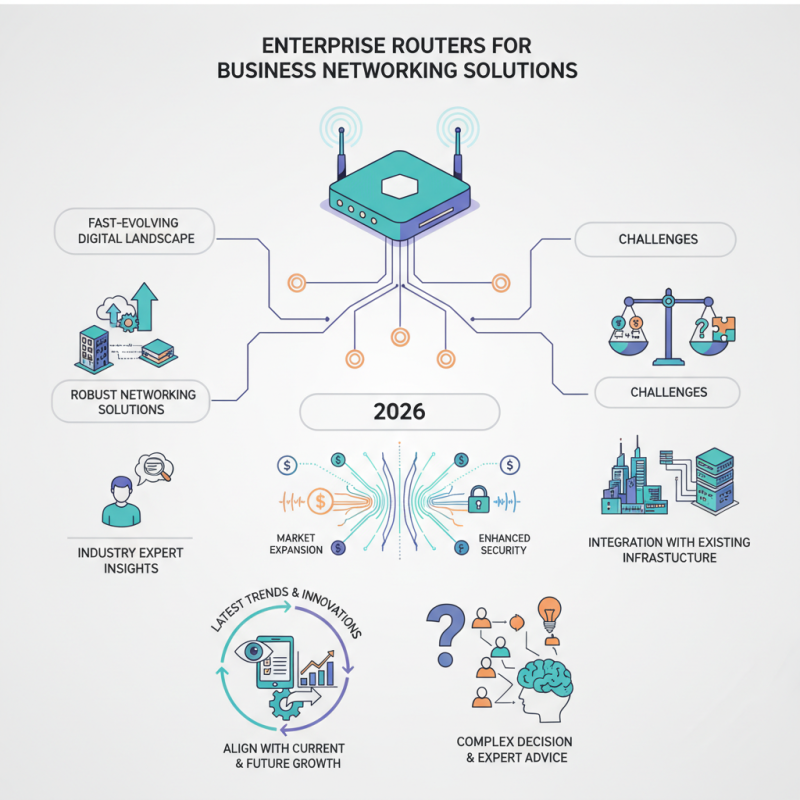
In today's fast-evolving digital landscape, the role of Enterprise Routers has never been more critical. With businesses increasingly reliant on robust networking solutions, the demand for high-performance routers is at an all-time high. Industry expert Jane Smith, a renowned analyst at TechNet, states, "Enterprise Routers are the backbone of modern business communication." Her insights highlight the importance of reliable technology in enhancing organizational efficiency.
As we approach 2026, the market for Enterprise Routers is set to expand further. Companies are seeking solutions that not only improve connectivity but also enhance security. However, this rapid growth raises questions about scalability and adaptability in various environments. The challenge lies in choosing the right router to meet specific business needs. Many organizations face issues when integrating new technologies with existing infrastructures.
In this increasingly competitive landscape, businesses must stay informed about the latest trends and innovations in Enterprise Routers. Understanding the capabilities of different models will be crucial. As companies invest, they need to ensure their choices align with both current demands and future growth. It's a complex decision, requiring careful consideration and expert advice.
Overview of Enterprise Routers and Their Importance in Business Networking
Enterprise routers play a critical role in business networking. They facilitate communication across various departments, ensuring smooth data flow. With increasing reliance on digital operations, selecting the right router is crucial for efficiency and security.
These devices manage both internet access and data traffic within the network. They help prioritize critical data and maintain speed. A well-chosen router can significantly enhance productivity within the organization. However, many companies overlook the importance of features like security protocols and scalability.
Some businesses may invest in high-end routers without fully understanding their needs. This can lead to wasted resources and ineffective solutions. Regular assessment of network requirements is necessary. Improved performance and security come from a router that aligns with specific business demands.
2026 Top Enterprise Routers for Business Networking Solutions
| Router Model |
Maximum Throughput (Gbps) |
Number of Ports |
Wi-Fi Standard |
VPN Support |
Management Type |
| Model A |
10 |
8 |
Wi-Fi 6 |
Yes |
Cloud-managed |
| Model B |
12 |
12 |
Wi-Fi 6E |
Yes |
On-premises |
| Model C |
8 |
6 |
Wi-Fi 5 |
No |
Cloud-managed |
| Model D |
15 |
10 |
Wi-Fi 6 |
Yes |
On-premises |
Key Features to Consider in Top Enterprise Routers for 2026
When evaluating enterprise routers for 2026, several key features emerge. Performance is paramount, with speed and reliability being critical for business operations. A router must efficiently handle multiple devices and large data volumes. Look for capabilities that ensure seamless connectivity, even during peak usage times.
Security is another essential consideration. In a world where cyber threats are rampant, an enterprise router should offer robust encryption and firewall options. Features like advanced intrusion detection systems can provide peace of mind. Businesses should also consider how easily the router integrates with existing security protocols.
Scalability matters, too. As companies grow, their networking needs change. A router that can adapt to increased traffic or connect additional devices will prove invaluable. Flexibility in configuration can support unique business models. Reflecting on this, businesses must ensure their choices align with future expansion plans. Balancing immediate needs with long-term growth is crucial when investing in networking solutions.
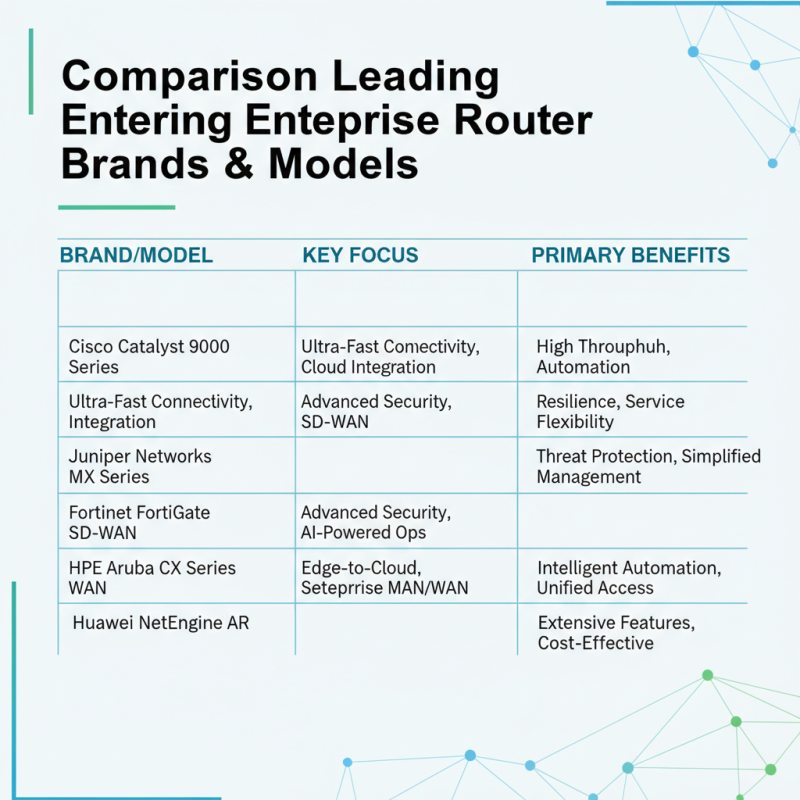
Comparison of Leading Enterprise Router Brands and Models
In the landscape of enterprise networking, routers play a crucial role. Choosing the right router can influence performance, security, and scalability. Various brands offer different features tailored for diverse business needs. Some routers focus on ultra-fast connectivity, while others excel in security protocols.
When comparing leading brands, consider speed, reliability, and ease of management. Some models have advanced features like traffic management and VPN support. However, not every brand is perfect. Users may face challenges with firmware updates or customer support. These factors can impact long-term satisfaction and effectiveness.
Generally, a robust router should adapt seamlessly to evolving business demands. Monitoring network performance is essential. Even reliable models can encounter issues under heavy loads. Evaluating user experiences can provide valuable insights. Recognizing the potential shortcomings of each model will help make informed decisions.
Trends in Enterprise Router Technology for Business Networking Solutions
The landscape of enterprise routers is evolving rapidly, driven by trends in connectivity and security needs. According to a recent report by the International Data Corporation (IDC),
75% of businesses are shifting towards cloud-based services, necessitating advanced routers that can handle increased traffic. This transformation highlights the importance of
high-performance routers that can support bandwidth-intensive applications.
Security continues to be a major concern. A study by Cybersecurity Ventures predicts cybercrime will cost businesses over
$10 trillion by 2025. Therefore, routers now come equipped with
integrated security features. Companies are investing in devices that offer real-time threat detection and multi-layered security protocols.
However, relying solely on hardware solutions can lead to complacency. Businesses must also prioritize staff training on
cybersecurity best practices.
Additionally, the push towards automation is transforming enterprise networking. A report by Gartner shows that
85% of network operations will be automated by 2025. Yet, this raises questions about reliability and human oversight. While automation can enhance efficiency, it can also
introduce new challenges in troubleshooting and maintenance. Finding the right balance will be crucial for businesses as they
adopt these emerging technologies.
Implementation and Best Practices for Using Enterprise Routers in Organizations
Implementing enterprise routers in business environments requires careful planning and attention to detail. Organizations must consider their unique networking needs. Each network is different, which makes standard solutions inadequate. Assessing bandwidth requirements and security concerns is essential. Many companies struggle with scalability. Yet, this is vital for accommodating growth.
Choosing the right routing protocol can be challenging. Some teams may opt for alternatives without fully understanding their implications. Opting for simpler configurations might seem attractive but can lead to issues down the line. Troubleshooting becomes harder when complexities are overlooked. Investing in training for IT staff is crucial. Well-informed teams can manage and adapt systems effectively.
Documentation of network architecture is often neglected. Without clear records, future modifications can become chaotic. Organizations should regularly revisit their network structures. Best practices encourage routine assessments of performance. Metrics should be monitored closely to identify bottlenecks early. Ultimately, a proactive approach can save time and resources.