Top Juniper Routers for Reliable Global Network Connectivity?
In today's interconnected world, reliable network connectivity is paramount. Juniper Routers stand at the forefront of this need. As Jim DeBarros, a renowned expert in network engineering, once said, "In a global economy, downtime is not an option." His words resonate deeply in the context of choosing the right router.
Juniper Routers have fostered advancements in network performance. They are known for their robust architecture and reliable performance. Organizations depend on these devices to maintain seamless communication across borders. However, with many models available, selecting the right one can be challenging.
Experts recommend thorough consideration of specific requirements. Each network is unique, with distinct demands. Therefore, evaluating performance metrics and scalability is essential. Juniper Routers also bring scalability challenges that require careful planning. A misstep in choice may lead to network inefficiencies, impacting business operations. Balancing reliability and complexity is crucial for success.

Overview of Juniper Networks and Their Impact on Global Connectivity
Juniper Networks has significantly shaped global connectivity through its innovative networking solutions. Their technologies are designed to support the demands of modern networks, which increasingly rely on high-performance routing and increased bandwidth usage. A recent report from Cybersecurity Ventures indicates that global IP traffic will reach 4.8 zettabytes per year by 2022, showcasing the growing need for robust networking solutions.
Their routing equipment plays a crucial role in managing this rising demand. Industry analysis shows that service providers are focusing on scalability and resiliency in their infrastructure. Juniper’s solutions offer enhanced capabilities to manage complex network environments efficiently. However, challenges remain. As networks evolve, maintaining compatibility with legacy systems can complicate upgrades.
Moreover, organizations must address security concerns amid increasing cyber threats. A study by the International Telecommunication Union found that 70% of organizations experience network interruptions due to security issues. Ensuring reliable global connectivity is not just about speed; it’s about resilience and security, too. Organizations must evaluate their infrastructure continuously to adapt to these ongoing challenges.
Key Features of Juniper Routers for Enhanced Network Reliability
When discussing enhanced network reliability, several key features of routers stand out. High throughput and low latency are notable. According to industry reports, routers with optimized hardware can achieve data rates exceeding 1 Gbps. Lower latency can improve real-time applications, which many businesses rely on daily.
Scalability is another vital feature. Routers must accommodate growing traffic without compromising performance. A recent survey found that 70% of IT leaders prioritize scalability when selecting networking equipment. This reflects the increasing demand for robust network solutions that can grow with business needs.
Tip: Always test the network infrastructure under simulated load conditions. This helps identify potential bottlenecks before they become critical issues.
Dependability is crucial too. Routers often feature redundancy options to prevent downtime. Reports indicate that companies implementing these systems report up to 60% less network downtime. Enhancing reliability requires constant assessment of both hardware and software.
Tip: Regularly update router firmware. This practice can mitigate security vulnerabilities and improve overall performance.
Top Juniper Router Models for Different Network Needs
When choosing routers for global connectivity, understanding your specific network needs is essential. Different environments require tailored solutions. For small businesses, entry-level models provide flexibility and ease of use. They can manage basic tasks effectively, but may struggle under heavy loads.
Mid-range models serve more robust requirements. They handle higher traffic volumes and provide better data management. Such routers often include advanced security features. However, users may find their configuration challenging without proper expertise. On the other hand, high-end routers are designed for large enterprises. These systems boast exceptional capabilities and reliability. Yet, they come with a steep learning curve and higher operational costs.
There's always room for improvement in network infrastructure. Balancing budget and technology can be tricky. Some users may regret overspending on features they don’t use. Therefore, assessing real requirements is critical. In an evolving digital landscape, adapting to new technologies is vital for sustained performance.
Top Juniper Routers for Reliable Global Network Connectivity
Comparative Analysis of Juniper Routers and Competitor Offerings
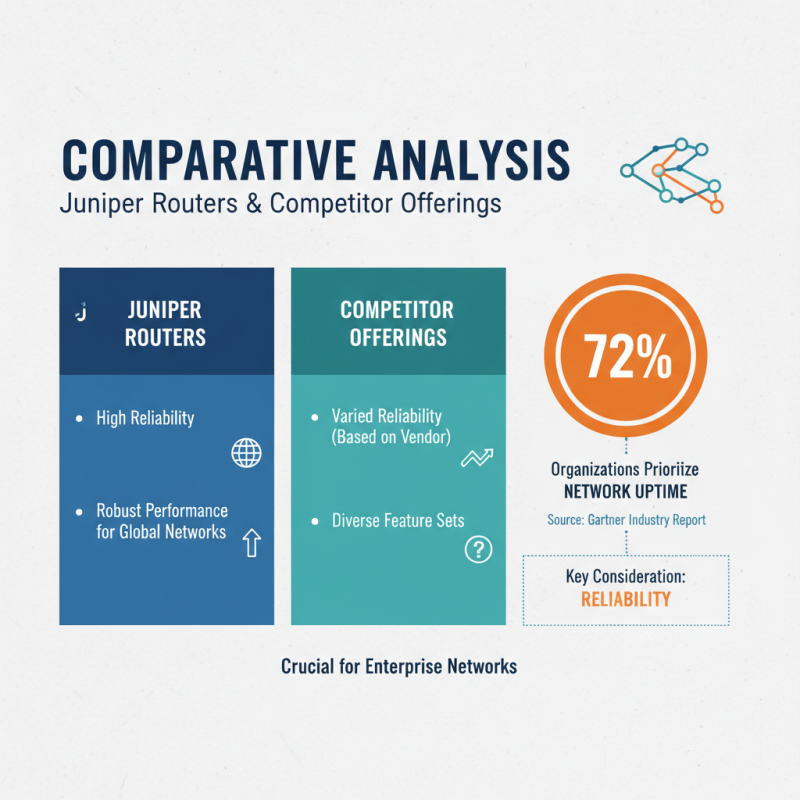
When choosing routers for global network connectivity, a comparative analysis reveals key differences between leading market options. Many studies show that reliability remains critical for enterprise networks. According to a recent industry report by Gartner, 72% of organizations prioritize network uptime when selecting routing solutions. This places considerable pressure on providers to ensure their hardware meets rigorous standards.
Additionally, performance metrics are essential. For instance, routers that efficiently handle traffic during peak loads are becoming increasingly important. A report from IDC highlights that a 30% increase in bandwidth demand is expected over the next five years. Providers must adapt by offering solutions that scale effectively. However, not all offerings deliver acceptable performance under stress, leading to potential downtimes.
Security and support are also significant. A survey shows that 56% of IT leaders cite security vulnerabilities as a primary concern in router selection. Many routers fall short in this area, lacking comprehensive updates or robust defense mechanisms. This raises questions about long-term reliability. Organizations must weigh choices carefully, as the cost of downtime can reach staggering figures in lost revenue.
Consideration of all these factors is crucial in the selection process. While some routers perform well in isolated tests, their practical application may vary greatly under real-world conditions. Companies need to remain vigilant and proactive in their assessments.
Best Practices for Implementing Juniper Routers in Global Networks
Implementing routers in global networks requires careful planning and execution. Selecting the right model can enhance performance and reliability. However, understanding your network's unique requirements is crucial. Analyze the expected traffic flow and the types of services you will provide. This ensures the router you choose can handle peak loads efficiently.
Once the appropriate router is chosen, configuration is the next step. It’s important to tailor settings to optimize speed and security. Too often, organizations underestimate the importance of proper configuration. Regularly review policies and update security settings to mitigate potential risks. Employee training on network management also plays a vital role. Without proper knowledge, even the most reliable systems can falter.
Monitoring network performance is another essential aspect. Leverage performance analytics tools to identify bottlenecks. Regular assessments help in understanding network health and maintaining optimal efficiency. However, many overlook small tweaks that can make a significant difference. Continuous improvement should be part of the network's culture, fostering resilience in an ever-changing digital landscape.
Top Juniper Routers for Reliable Global Network Connectivity
| Router Model |
Max Throughput (Gbps) |
Number of Ports |
Form Factor |
Key Features |
| Model A |
100 |
8 |
Rackmount |
High availability, QoS support |
| Model B |
200 |
16 |
Modular |
Enhanced security, advanced routing |
| Model C |
150 |
12 |
Desktop |
Energy-efficient, user-friendly interface |
| Model D |
250 |
24 |
Rackmount |
High performance, scalable architecture |